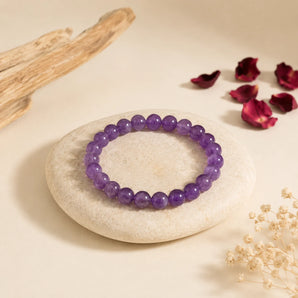
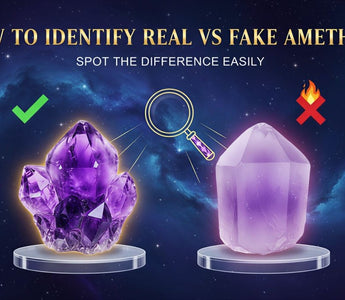
Amethyst — the mesmerizing purple crystal of calm, intuition, and spiritual balance — is one of the world’s most loved gemstones.
But did you know that a large percentage of Amethyst sold today is fake or artificially enhanced?
In this guide, we’ll teach you how to tell real Amethyst from fake, spot heat-treated or glass imitations, and make sure you invest in a crystal that holds true energy.
🔮 What Is Amethyst?
Amethyst is a purple variety of Quartz, colored by trace amounts of iron and natural irradiation over millions of years.
It’s known as the Stone of Spiritual Wisdom and has been used since ancient times for clarity, peace, and protection.
- Color: Light lavender to deep royal purple
- Chakra: Crown & Third Eye
- Energy: Calming, spiritual, purifying
- Origin: Brazil, Uruguay, Zambia, and India
💎 Why So Many Fake Amethysts Exist
Because of Amethyst’s global popularity, imitations and heat-treated stones are widely sold — especially online and in commercial markets.
The most common “fake” Amethysts include:
- Dyed Quartz or Glass
- Synthetic Amethyst (Lab-grown Quartz)
- Heat-treated Amethyst (to enhance or change color)
Some are real Quartz but color-enhanced; others are entirely artificial.
🧠 How to Identify Real vs Fake Amethyst
Here’s a complete breakdown so you can spot the difference with confidence:
| Feature | Real Amethyst | Fake Amethyst (Glass/Dyed) |
|---|---|---|
| Color | Naturally purple, may have light and dark zones | Too bright, uniform purple or pinkish hue |
| Clarity | Slight inclusions or wispy patterns | Bubbles or overly flawless |
| Temperature | Cool to touch even after holding | Warms quickly (like glass) |
| Hardness | 7 on Mohs scale (can scratch glass) | 5–5.5 on Mohs (glass or plastic) |
| Weight | Slightly heavier than glass | Lighter or hollow feel |
| Price | Moderate to high for deep color | Very cheap or bulk pricing |
💫 1. Examine the Color
👉 Real Amethyst:
Has zoning — meaning the purple shades vary subtly throughout the crystal. You may notice lighter and darker patches or color bands.
The tone can range from pale lavender to deep violet, but it’s never too uniform.
👉 Fake Amethyst:
If the stone looks too perfect, overly bright, or neon purple — it’s probably dyed or synthetic.
Some fakes even have a reddish or pinkish tint that looks unnatural.
🔍 2. Check for Inclusions and Bubbles
Hold your crystal under bright light.
- Natural Amethyst: Tiny mineral inclusions, internal fractures, or color zoning.
- Fake Amethyst (Glass): Small bubbles — a clear giveaway of glass or resin.
💡 Pro Tip: Use a 10x jeweler’s loupe to check inside your stone.
🧊 3. Feel the Temperature
Amethyst (like all Quartz) feels cool to the touch — even in warm conditions.
Glass or plastic, on the other hand, warms up quickly in your hand.
This is one of the easiest home tests for quick verification.
⚡ 4. The Hardness Test (Caution)
Amethyst has a hardness of 7 on the Mohs scale, while glass is around 5.5.
A real Amethyst can scratch glass — but do not perform this test unless necessary, as it might damage your crystal.
🔥 5. Heat-Treated Amethyst
Some sellers heat Amethyst to enhance color — or even transform it into Citrine.
While still Quartz, these are treated stones, not natural Amethyst.
You can identify heat-treated Amethyst by:
- Orange, reddish-brown undertones
- Strong color at tips and faded base
- Burnt look or smoky hue
6. Professional Lab Testing
To be 100% sure, send your crystal to a gemological lab for:
- Refractive Index Test: Real Amethyst = 1.54–1.55
- Spectral Analysis
- UV Reaction (Natural vs Synthetic)
At World of Oorja, all Amethyst pieces are lab-tested and certified for authenticity, ensuring you receive only genuine, high-vibration crystals.
How to Choose Genuine Amethyst When Buying
- Buy from certified sellers who provide authenticity reports.
- Avoid neon-purple stones at suspiciously low prices.
- Look for natural inclusions or slight color variation.
- Trust your intuition — genuine crystals feel energetically calm and cool.
🌙 Cleansing
Once you confirm your Amethyst is real:
- Cleanse under with sage smoke.
- Set your intention: “I invite peace, intuition, and divine clarity.”
- Avoid harsh sunlight, as it can fade the purple color.
💬 Final Thoughts
Identifying real vs fake Amethyst isn’t just about looks — it’s about energy.
Natural Amethyst carries a vibration of purity and higher consciousness that synthetic imitations can’t replicate.
By learning these simple identification steps, you can ensure every piece you buy is authentic, high-quality, and energetically alive.
At World of Oorja, we proudly offer authentic, lab-certified Amethyst crystals so you can heal, manifest, and meditate with confidence.