

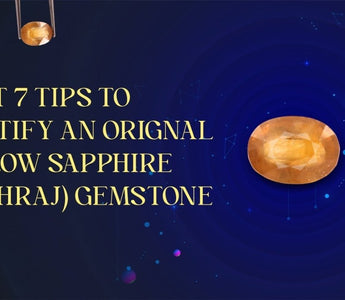
What if the gemstone you bought with so much hope turns out to be nothing more than colored glass? For anyone seeking the blessings of Jupiter (Guru) through a Yellow Sapphire (Pukhraj), this thought can be heartbreaking. In India, where astrology is woven into our culture, gemstones are not just ornaments—they are spiritual investments. Yet, the sad reality is that the gemstone market is full of fakes, from synthetic lab stones to simple glass pieces painted yellow.
Whether you are buying your first Pukhraj or upgrading to a better stone, knowing how to spot a real one is crucial. You don't need to be an expert, but you do need to know these 7 simple tips.
What Is Yellow Sapphire (Pukhraj) and Why Authenticity Matters
1. Look for Natural Inclusions
Nature is rarely perfect. A natural Pukhraj grows deep inside the earth over millions of years. This process leaves behind tiny "fingerprints" called inclusions. These might look like small fibers, feathers, or liquid veils inside the stone.
If you look at the stone through a 10x magnifying glass and it appears 100% crystal clear like a drop of distilled water, stay alert. It is very likely a piece of glass or a high-quality synthetic stone. Original stones will almost always have some internal life.
2. Check for Tiny Air Bubbles
This is a very simple but effective test. Hold the gemstone up to a bright light and look closely. Do you see tiny, perfectly round air bubbles? If yes, you are looking at glass.
During the manufacturing of glass fakes, air gets trapped inside, creating round bubbles. Natural sapphires may have inclusions, but they are never perfectly round bubbles. If it looks "bubbly" inside, it’s a fake.
3. The Hardness Test
Yellow Sapphire is an incredibly hard gemstone. On the Mohs scale of hardness, it ranks at 9. To give you context, only a Diamond is harder than a Sapphire.
Because it is so hard, an original Pukhraj will not get scratched by a coin, a knife, or a piece of glass. If you see scratches or "scuff marks" on the surface of the stone after a little bit of wear, it is likely a softer substitute like Yellow Topaz or Citrine, or simply colored glass.
4. Sharpness of Facets (Edges)
Look at the "cuts" or the edges where the sides of the stone meet. Because an original Pukhraj is very hard, the edges where it has been cut will be very sharp and crisp.
In glass or plastic fakes, the material is soft. Over time (or even during the molding process), these edges become rounded and blunt. If the edges look soft or melted, it’s a sign that the material isn't a real sapphire.
5. Evenness of Color
While natural sapphires can have color zoning, the color should look "integrated" into the stone. Some fakes are made by taking a clear stone and coating it with yellow dye.
If you see the color concentrated only in the cracks or if the color seems to be "peeling" at the edges, it is a dyed fake. Also, if the yellow looks too "neon" or "fluorescent," it might be a chemically treated stone. Natural yellow has a warm, golden glow.
6. The Temperature Test
Gemstones are excellent conductors of heat. When you pick up an original Pukhraj, it should feel relatively cool to the touch. It also dissipates heat quickly.
If you hold a stone in your hand and it warms up almost instantly to your body temperature, it might be plastic or glass. Real gemstones have a certain "heaviness" and "coolness" that synthetic materials lack.
7. Ask for a Laboratory Certificate
This is the most professional and foolproof way to identify an original gemstone. Always insist on a certificate from a reputed, independent gemological laboratory (like GRS, IGI, or local government-approved labs).
A proper report will mention:
- Whether the stone is Natural or Synthetic.
- If it has undergone any Treatments (like glass filling or heavy heating).
- The exact Weight and Origin.
If a seller makes excuses about providing a certificate, it is a major red flag.
Final Thoughts: Trust Matters More Than Price
A gemstone is more than a purchase—it is a promise. A promise of better health, prosperity, peace, and spiritual growth. But this promise can only be kept if the stone you wear is genuine. A fake Pukhraj is not just a financial loss; it is a betrayal of your faith and hopes.
The good news? With the right knowledge and a trusted source, finding an authentic Yellow Sapphire is not difficult. Armed with these 7 tips, you can now walk into any gemstone shop with confidence. You know what to look for, what questions to ask, and when to walk away.
Remember, in matters of gemstones and destiny, never compromise on quality. Your astrological remedies deserve the best.
Ready to bring home a real Pukhraj?
Explore the collection of natural, lab-certified Yellow Sapphire gemstones at World of Oorja. Each stone is handpicked, tested, and certified—so you can wear it with complete peace of mind.
Visit worldofoorja.com and let the blessings of Guru transform your life.









%20Gemstone)